Forest Route ⋅ 10

Off to the forest!
A tour through the species-rich Ittingen Forest.
Ittinger Waldrundgang
The Ittinger Forest has a fascinating and well-documented history. Thanks to its geology and location, it boasts a variety of microclimates, plant communities and wetlands with waterlogged soil, as well as exotic tree species and the canton of Thurgau's first total reserve, designated in 1997. Today, the Ittinger Forest is an important part of the "Landscape of National Importance between the Thur and Rhine".
Publikation «Führer durch den Ittinger Wald»
Guide to the Ittingen Forest, published in 2005 and written by August Schläfli, the former long-standing director of the Thurgau Nature Museum, provides a comprehensive description of the forest. Due to the natural changes that forests undergo over time, the circular walk described in the guide requires some minor adjustments. A new brochure has been produced in collaboration with the Thurgau Forestry Office – you can find it below as a PDF – and the printed brochure is available free of charge from the monastery shop. The brochure's information can also be found here.
Brochure (in German)
Duration approximately 90 minutes
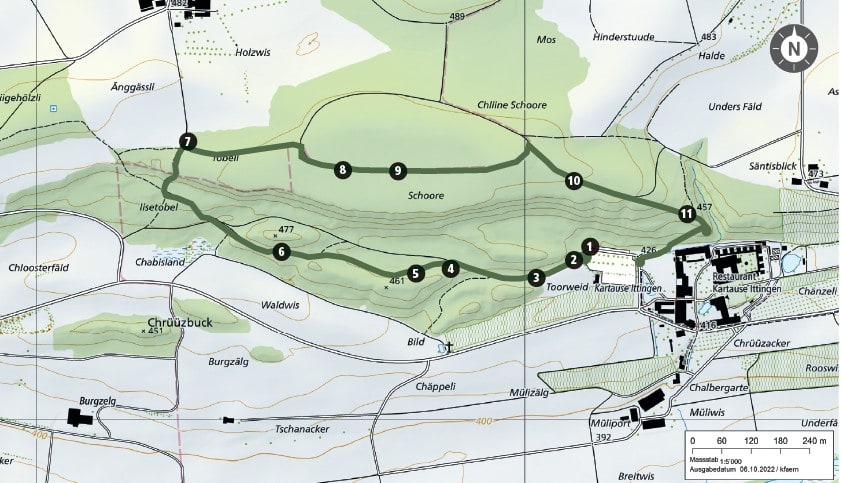
Join the forest tour to learn interesting facts about the Ittinger Forest on a two-and-a-half-kilometre walk with eleven stops. You can access additional information online via QR codes.
Tip
We also offer guided tours of the Ittinger Forest for groups.
For enquiries: T 058 345 10 60 or sekretariat.kunstmuseum@tg.ch
1 - History of the Ittingen Forest
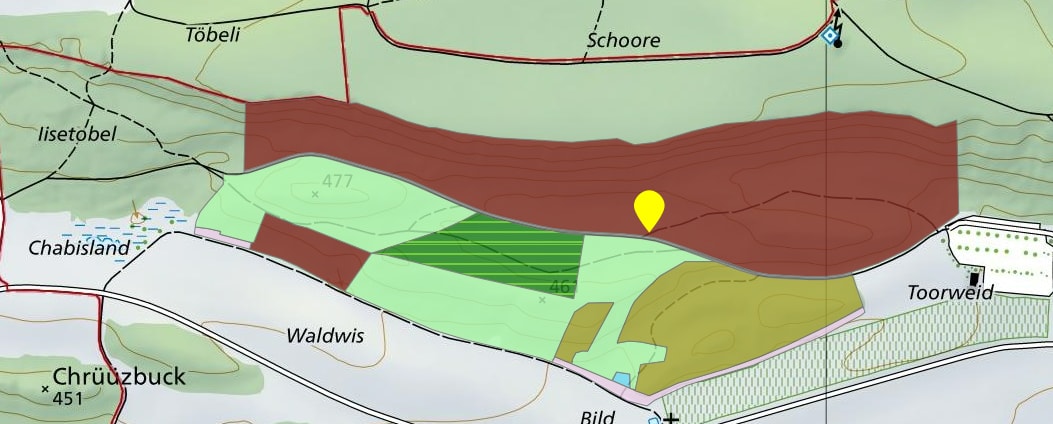
In 1848, the Thurgau Grand Council decided to abolish all monasteries in Thurgau. As a result, the forests belonging to Ittingen Monastery became part of an agricultural estate. The Fehr family managed this estate from 1867 to 1977. Forest use was extensive, especially in the last decades of the Fehr family's ownership. In 1977, the Kartause Ittingen Foundation acquired the former monastery complex, and at the same time the nearby Ittingen Forest was taken over by the Thurgau State Forestry Administration. This marked the beginning of a period of intensive forestry, which was particularly evident in the clearly visible rejuvenation of the forest. In 1997, the Ittingen Forest was sold to the Kartause Ittingen Foundation on the condition that almost half of the forest area be designated as a reserve. Of the approximately 32 hectares of Ittingen Forest, 14 hectares are now forest reserves and about two hectares are protective forests. The remaining 16 hectares are managed in a near-natural way. You can find out more about this at location 2.
2 - Protected forest
They stand at the edge of the forest reserve, which has been in existence since 1997. North of the forest road, the forest is left to develop naturally, a process known as succession, and no forestry work is carried out. In this core zone of the reserve, the effects of non-intervention can now be seen, with individual standing or fallen trees (spruce, beech, ash) decaying. Various fungi can be found on these trees. Microhabitats for different animals and plants can also be observed. South of the forest road lies the managed part of the reserve, the special forest reserve.
3 - Animals in the Ittinger Forest
Mice, dormice, squirrels, hedgehogs, foxes, badgers, hares, roe deer and wild boar are among the mammals that inhabit the Ittingen Forest. Observing them requires time, patience and knowledge. However, footprints in the wet mud are evidence of their presence. Around 50 species of birds live in the forest of Kartause Ittingen, as well as less conspicuous animals such as snails and ants. In addition, the presence of seven species of bats indicates that this forest provides diverse and intact habitats, and with a little luck you can observe various butterflies.
4 - Geology around Kartause Ittingen
The terrain here is characterised by steep, open scree slopes and ridge-like small hills, known as camel humps. This rare geological formation is considered a geotope of national importance. This landscape was created during the last ice age. The steep slope consists of ‘pitted Nagelfluh’, which was brought here from the Grisons Alps by the Rhine Glacier. This glacier spread out in the open Lake Constance area like a delta to form a broad foreland glacier extending beyond what is now Schaffhausen. The hills are post-glacial landslides and subsidence areas that detached from the steep slope. During the last ice age, there was a 400-metre-thick layer of ice in this area. As the glacier melted, the huge ice field split into individual tongues, for example in the Upper Rhine/Untersee region, in the Seebach Valley and in the Thur Valley. Due to the slow release of the ‘Ittinger Berg’ from the ice and the melting of the ice support on the steep slope, it is easy to imagine that the relieved and still vegetation-free slope lost its grip and subsided in layers on the waterlogged ground towards the Thur. Even today, the slope still slides slightly. The overgrown scree slopes below the rock bands cover the entire width of the steep slope. Water accumulated between the layers, leading to the formation of wet depressions and small moors.
5 - Foreign tree species in the forest
Exotic species of tree are those that are not native to our region, or at least have not been since the last Ice Age. In the 19th century, trees originating from North America were planted in various locations across Switzerland. Alongside the predominant native beech tree, the Ittingen Forest also contains Douglas firs, red oaks, thuja and hemlock firs. The Douglas fir is native to Oregon, while the red oak comes from eastern North America. The thickest trees along the path are exotic species. The Douglas fir (Pseudotsuga menziesii) is an evergreen conifer. In Europe, it can grow to around 60 metres tall. Its needles are green to blue-green in colour, solitary, soft and blunt. They are three to four centimetres long and give off an aromatic, lemon-like scent when rubbed. Douglas firs can be confused with spruce and fir trees. Unlike spruce trees, the needles of Douglas firs sit directly on the branch, but unlike fir trees, their base is not thickened. The bark can also be used to distinguish between the two. Both types of bark have a similar colour, but the pattern and indentation differ. Douglas fir bark is quite firm and has many long, deep grooves. In contrast, the bark of fir trees is significantly smoother and greyer. It only cracks with age. Spruce trees, on the other hand, have no grooves and their bark tends to split into small, round flakes that can easily be removed by hand. The red oak (Quercus rubra), also known as the American oak, owes its name to its leaves, which turn bright orange to red in autumn. Relatively large at 10 to 25 centimetres, the otherwise dark green leaves are deeply incised with pointed lobes at the front. The grey bark remains smooth for a long time and later forms bark that is not deeply fissured.
6 - Beech forests in the Ittinger Forest
Forest communities describe the characteristic occurrence of plants at a specific location in the forest. In Ittinger Forest, for instance, various beech forest communities predominate. As the name suggests, the main tree species is beech. The bark of the beech tree is lead grey and fairly smooth. Beech leaves are oval with a pointed tip, measuring approximately five to ten centimetres in length and three to seven centimetres in width. The leaf stalk is about one and a half centimetres long. The beech forest communities found in the Ittinger Forest reflect the terrain. The typical lungwort beech forest is found on relatively flat terrain, the lungwort beech forest with bee balm is found on the slopes, and the typical white sedge beech forest is found on small hills and slopes. The woodruff beech forest is most common on the plateau above the steep slope. The forest landscape of the typical lungwort beech forest is ideally hall-like, with strong, straight trunks. Before the beech leaves sprout, many spring flowers such as wood anemones, mercury, woodruff, arum, toothwort and lungwort form a dense carpet on the forest floor. Once the leaves have sprouted, however, the forest becomes too dark for many of these plants and they disappear.
In Thurgau, 80% of the area would naturally be covered with beech forest communities. However, over the centuries, the promotion of other tree species, such as spruce, silver fir, pine and oak, has pushed back the beech, meaning that spruce and other tree species also grow in typical beech forest locations.
7 - Forest edges and ecology
If you look west, you can see the edge of a forest on your left. These edges are ecologically valuable, forming transitions between open land and forest. Humans began clearing forests to obtain wood for construction, crafting, and fuel, as well as to create fields and pastures. This created a cultural landscape divided into compartments of forest and open land. Human influence gave these compartments sharp edges, which we are familiar with in today's cultural landscape and which determine our perception of forest edges. Nevertheless, forest edges in our area can be differently shaped and structured, and are mostly the result of human cultivation. They usually consist of a herbaceous fringe, a shrub belt and a forest canopy. These forest edge elements can also be arranged in a mosaic-like pattern.
8 - Biotope on the Ittingen Plateau
In spring and after heavy rainfall, pools of water form in the shallow depressions to the south of the path. Although the water does not remain for long, the forest community found at this location makes this place stand out clearly from the surrounding woodruff beech forest, even in summer. This community comprises several moisture-loving species, such as black alder, hornbeam, wood betony, lesser celandine, loose-flowered sedge, giant fescue, rushes and ferns. Moss-covered stems indicate the approximate former water level at the base. These pools in waterlogged soil form a valuable habitat for various rare and partly protected animals, such as dragonflies.
9 - Logging in the Ittingen Forest
Wood is regularly harvested for personal use in Kartause Ittingen's commercial forest. The forest is managed according to the principles of natural and site-specific silviculture. Various management methods are employed. Between 2018 and 2022, the Ittingen forest was also ravaged by bark beetles. Almost all spruce trees with a diameter of between 21 and 35 centimetres were infested and had to be felled. These areas were then replanted with species of tree adapted to the location. Acorns were collected locally and scattered in the resulting clearings. Where natural regeneration was not expected, various trees were planted.
10 - Oak, the tree species of the future?
Looking south, you can see a solitary oak tree with rough bark. This species of tree is not very common in nature because it is outcompeted for light by beech and ash trees. Oaks are distinctly light-loving and thrive in the mild, warm summer climate of low-lying areas suitable for viticulture and fruit growing. It is generally considered to be robust. However, when young and in leaf, it is vulnerable to snow pressure (wet snow) and late frosts. Because it is a heat-loving species and robust in the face of drought, the oak is expected to fare well in the anticipated climate change. However, it is often browsed by roe deer. To successfully regenerate oak trees, the plants must be protected accordingly.
11 - Forest protects the Kartause Ittingen
Special management principles apply within the blue-hatched area. The former monastery is located directly below the ravine, where a small stream flows at the bottom. The stream swells during periods of heavy rainfall. This part of the Ittingen Forest is therefore designated as a protective forest. Protective forests are managed according to different criteria to normal commercial forests. The top priority is forest stability, so that it can fulfil its protective function. Therefore, what is needed is a continuously stable forest. This has been achieved by promoting yew trees that have grown naturally since the 2000s. Field maple, hazel and yew trees are specifically promoted on the slope above the monastery wall.